Why brokers are still switching to Pelican
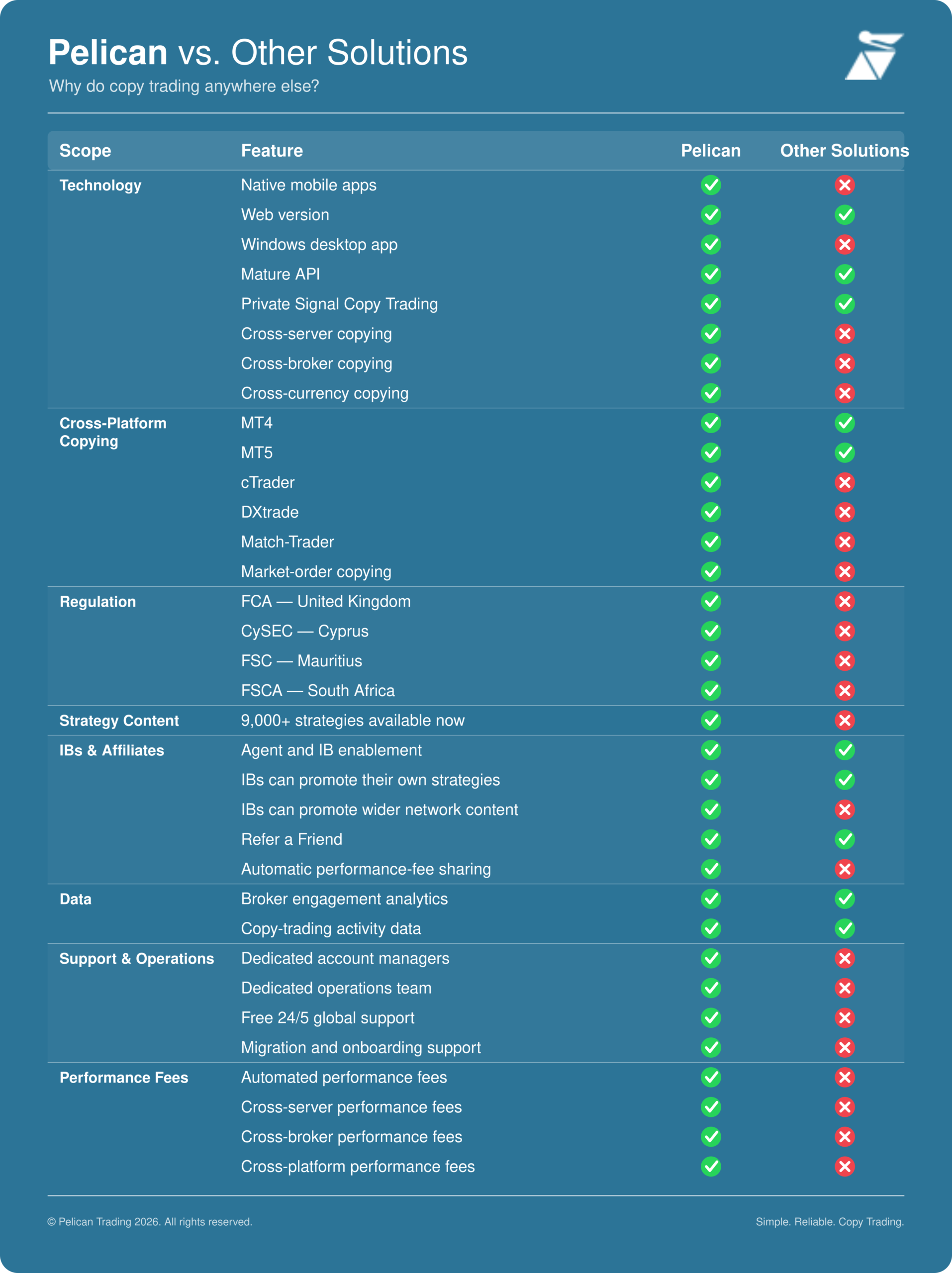
Twenty brokers have moved their copy trading to Pelican this year. Every one of them left another provider to do it.
Switching copy trading provider is a big decision. Strategies and copiers have to migrate, and dealing and payments processes have to be rebuilt around a new system. Brokers don’t take that on unless they know the new setup is worth it.
So why the migration?
On a lot of copy trading platforms, copy trades bypass the dealing team completely and go straight to the ledger. There’s no visibility of trade flow, which means no way to manage A-book or B-book exposure on a growing share of client volume.
That turns a revenue feature into a risk management problem. The more successful copy trading becomes on the platform, the larger the blind spot gets.
Pelican keeps copy trades inside the broker’s own risk management. Dealing teams see and manage copy trading flow the same way they manage everything else.
Cross-platform capability is claimed widely. In practice, a lot of providers can only connect accounts that sit on the same server. Where cross-server copying does exist, it can leave trades hanging: isolated positions that never close properly.
Currency is a similar story. On some platforms a EUR copier can’t follow a USD strategy, which removes a large part of the strategy pool for any trader who doesn’t hold the base currency. Cent and micro accounts cause compatibility problems that many platforms still haven’t resolved.
Pelican copies across currencies and servers as standard. One network connects MT4, MT5, cTrader, DXtrade, Match-Trade and TradeLocker, so a trader on MT5 can copy a strategy running on cTrader at a different broker. That network holds over 9,000 strategies from more than 60 brokers.
Without cross-server automation, performance fees have to be calculated and processed manually by dealing and payments teams. That’s manageable at low volume. It stops being manageable as the broker scales, which is exactly when copy trading should be paying off.
Pelican calculates and pays performance fees automatically in-app. On average, over $2m a month is paid out to strategy providers and IBs across the network.
Some providers charge for support tickets, so brokers pay to have their problems investigated. Data tracking is often limited too, leaving brokers without the analytics they need.
Pelican provides free 24/5 support through dedicated support and operations teams, alongside fully branded apps and a mature API for custom integrations.
Brokers running copy trading across several markets can end up managing separate regulatory vendor relationships alongside their technology provider. Pelican holds permissions from the FCA, CySEC, DFSA, FSC Mauritius and FSCA, under a single regulatory infrastructure.
Pelican was built copier-first. That left one area where some competitors held an advantage: tools for IBs to promote their own strategies outside the leaderboards.
That gap is closed. Through the Private Signal View, the IB Portal and Refer a Friend, IBs can promote their own strategies or content from more than 9,000 strategies across the network. When referred clients start copying, the IB automatically receives a share of the resulting performance fees.
The pitch for copy trading used to be the size of the strategy pool. For the brokers switching now, the deciding question is what happens after a trade is copied, and whether their own teams can live with it at scale.
Pelican can be reached at sales@pelicantrading.io
Copy trading involves significant risk. Between 74-89% of retail investor accounts lose money when trading CFDs. You should consider whether you understand how copy trading works and whether you can afford the high risk of losing your money.
Don’t invest unless you’re prepared to lose all the money you invest. This is a high-risk investment, and you should not expect to be protected if something goes wrong.
This is a marketing communication and should not be taken as investment advice, personal recommendation, or an offer of, or solicitation to buy or sell, any financial instruments. This material has been prepared without having regard to any particular investment objectives or financial situation. Any references to past or future performance of a financial instrument are not, and should not be taken as a reliable indicator of future results.