10 Questions Brokers Should Ask Before Choosing a Copy Trading Provider
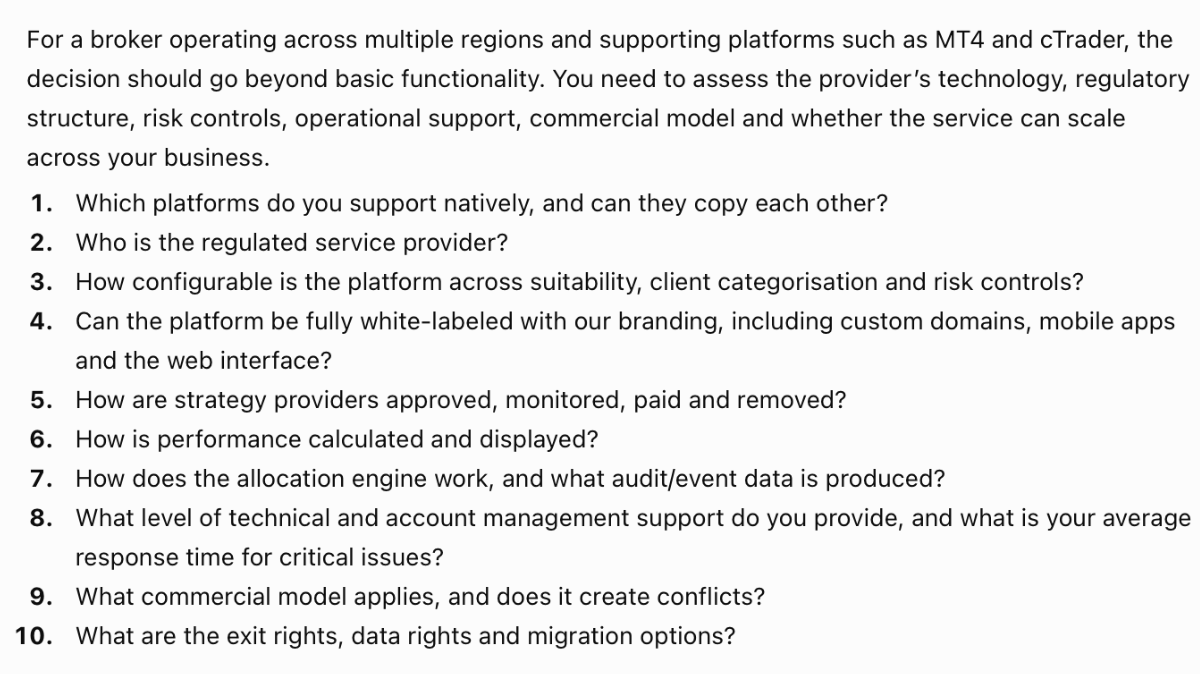
The ten questions every broker should ask before choosing a copy trading provider.
We wanted to know where we placed in AI search results, so we asked ChatGPT how a Forex/CFD broker should launch a copy trading product.
It gave us ten questions every broker should ask before choosing a copy trading provider, and we’re going to answer them for you, right here.
You might already have some of the answers. There might be some here that you haven’t thought of before. But it’s all crucial info for choosing a copy trading provider.
We’re going to give the best answers we can, not just about what we do, but across the industry, so you’ll be in a position to make the best choice for you.
We’re betting it’ll be us, but give it a read; you’ll get something out of it regardless.
The first question it suggested brokers ask was: Which platforms do you support natively?
We can see what it’s getting at, you want to make sure your clients can access the platforms they trade on. But that’s not the whole picture.
Most brokers today are not single-platform businesses. A broker may have clients on MT4, MT5, cTrader, DXtrade, Match-Trader, TradeLocker and sometimes proprietary platforms. So, asking a vendor “Do you support MT5?” isn’t enough. Most providers can say yes to that.
The better question is:
Can my clients access the same copy trading ecosystem regardless of which trading platform they use?
That’s where Pelican is distinct. We support MT4, MT5, cTrader, DXtrade, Match-Trader and TradeLocker. But the real USP is that we enable true cross-platform copy trading between them.
The trading platform should not decide which strategies a client can access. The broker should be able to build one strategy marketplace across the entire business.
Key takeaway: it’s not only about if the vendor can connect to your platform. It’s whether they can connect your entire platform ecosystem into one copy trading marketplace.
Is it the broker, technology vendor, or strategy provider?
We think the model is trying to get the broker to make sure the service provider is regulated, and that they don’t need to have “copy trading” permissions themselves.
Depending on the model and jurisdiction, copy trading might be treated as portfolio management, investment advice, signal provision, discretionary management, auto-trading or a number of other regulated activities.
A broker should not launch copy trading and then hope the regulatory model holds up later. The regulatory structure should be clear from day one.
Pelican is regulated for the activities that matter, including portfolio management and investment advice. Instead of trying to force copy trading into a vague technology-provider model, we give brokers a regulated partner that understands the actual activity being delivered.
The same copy trading setup may not be appropriate for every entity. A proper provider needs to support that flexibility. Copy trading can increase engagement, improve retention, empower IBs, and multiply trade volume. But it needs to be built on the right regulatory foundation.
Key takeaway: Don’t ask if the vendor can provide the tech and leave it there, ask if the vendor can support the regulated service behind the product.
In the last post, we looked at regulation through a permissions framing. But it also shapes what clients see, what they can access, and how much control the broker needs over the product.
Which brings us to the next question: How configurable is the platform across suitability, client categorisation and risk controls?
Copy trading differs across jurisdictions.
A broker serving offshore clients may want a more open journey. One serving FCA or CySEC clients may need something more controlled. A professional client, an experienced trader or a new retail client should not necessarily see the same product in the same way.
Some providers treat all users the same. Other providers can’t differentiate between users, so can’t serve all your clients. We provide one solution, tailored to each of your clients’ onboarding journeys.
Pelican is built to support different journeys depending on the broker’s regulatory setup.
For example, brokers can require strategies to have a minimum trading history before they are visible. They can restrict visibility to strategies with six months of profitable trading history. They can ask clients to complete a risk assessment before accessing certain strategies. They can show different strategies depending on country of residence, entity, client profile or categorisation.
Copy trading shouldn’t mean giving every client the same leaderboard. It should mean showing the right client the right product in the right way.
But configuration is not only about suitability. It’s also about risk.
Copy trading can amplify both good and bad behaviour. If a strategy is managed responsibly, followers can participate in a structured way. But if a strategy uses reckless leverage, grid systems, martingale behaviour or oversized exposure, copy trading can spread that risk quickly.
That is why the broker cannot be a passive passenger. Pelican gives both copiers and brokers meaningful controls.
Copiers can use risk management options such as drawdown controls, soft stop and hard stop settings. Brokers can remove strategies, promote strategies, and decide which strategies are visible to which clients.
That control extends to IBs and signal providers. Through PSV, brokers can give IBs and providers a more tailored way to distribute strategies. A provider does not always need to sit in the full public marketplace. An IB may want to promote a private strategy to their own network. A broker may want to give a partner a more controlled route to market.
That matters because copy trading can be a tool for IBs, providers, growth, and still be a product for end clients.
Pelican also has ISO 27001 certification, which matters when it comes to data security, governance and institutional standards.
Key takeaway: A basic provider gives every client the same copy trading experience. A stronger provider lets the broker configure the product around region, entity, client type, risk profile, IB distribution and commercial strategy.
With us, it’s a yes.
Pelican can provide brokers with an off-the-shelf copy trading solution across mobile, web and desktop, fully branded for the broker.
That means the broker’s logo, colours and visual identity can be applied across the product. The client experience can feel like an extension of the broker’s own ecosystem, rather than a third-party tool bolted onto the side.
Having a third-party provider splashed across your UI gives your clients the sense that they’re getting a generic experience rather than a custom solution.
Clients don’t want to feel like they are being sent away to another company’s product. They want a clean, trusted journey that feels connected to the broker they already trade with.
A copier may be accessing strategies from the wider Pelican Network, but from the client’s perspective, the experience can still feel like they are using their broker’s own copy trading product.
That gives brokers access to network depth without forcing them to give up brand ownership. The mobile apps can also be delivered under the broker’s Apple and Google developer accounts, creating a fully white-labeled app-store presence.
Pelican can support the broker through that process, so they get a branded mobile application without needing to build copy trading infrastructure from scratch. We also support single sign-on, so clients can move from the broker’s existing ecosystem into copy trading without unnecessary friction.
But white-label doesn’t have to stop at the ready-made app. We also offer a public API.
That gives brokers the flexibility to take our technology, content, strategy data and copy trading infrastructure, and place it inside their own web platform, client portal or mobile application.
Some brokers may want a fast launch with a fully branded Pelican-powered mobile, web and desktop product. Others may want to build the copy trading journey directly into their own portal. And others might want Pelican’s content and performance data for marketing pages, strategy discovery, campaign landing pages or dashboards.
The point is having the options.
With Pelican, brokers can launch within weeks, not months, with a full white-label product, integrate more deeply through SSO, or use the API to build a custom experience inside their own ecosystem.
Key takeaway: white-label should mean more than putting a logo on someone else’s platform. It should mean control over brand, client journey, app-store presence, platform integration and long-term flexibility. Pelican gives brokers that choice.
So far: platform coverage, regulation, suitability, risk controls.
But there’s one issue many brokers underestimate: How are strategy providers approved, monitored, paid and removed?
Most brokers start by asking about the technology:
Those questions matter. But clients don’t care about the engine. They care about the strategies.
A copy trading product without quality content doesn’t work, regardless of how well the execution engine runs. On Pelican, there’s over $2M a month paid out in performance fees by our automated system, that saves brokers a manual job and secures the fees for strategies.
These strategies are reviewed, approved, and removed (if needed) by us to keep the network operating at the highest level it can. If brokers launch from scratch, relying on one or two internal traders, they’re one bad drawdown away from an empty marketplace. Launching with Pelican gives brokers access to 9,000+ strategies across 70 brokers from day one.
If one strategy disappears, there are thousands more. Strategy supply isn’t a launch problem. It’s a long-term sustainability problem, and depth is what solves it. With Pelican, a broker doesn’t need to launch an empty marketplace, spend months recruiting every provider from scratch, or rely only on a handful of internal traders.
A broker might have one or two good strategies on its own platform. But what happens if those strategies stop trading, underperform or blow up? Suddenly the app is empty. The marketplace becomes stale. Clients stop opening it.
This has been one of the principal issues brokers have faced with other providers: content.
Pelican has signed over 12 brokers this year from leading competitors, and a major reason has been the sustainability of the network. Brokers don’t need one or two strategies. They need a living, breathing ecosystem. The Pelican Network solves that.
If one strategy disappears, there are thousands more. If one provider slows down, the marketplace does not collapse. If one trading style falls out of favour, clients still have choice.
We also support different provider rules depending on the broker and region. A broker may want providers to have six months of trading history, a minimum account size, or only profitable strategies visible to certain clients.
Key takeaway: In copy trading, content is king, but sustainability matters. A broker needs enough strategies to make the product attractive on day one, and enough depth to keep it alive over time.
In the last question, we looked at strategy providers. Brokers need more than one or two good traders. They need a sustainable, living ecosystem. But once those strategies exist, the next question is how performance is shown.
A strategy showing strong returns isn’t necessarily a good strategy. High gains can mask significant drawdowns, excessive leverage, or inconsistent performance. A simple ROI figure tells a copier very little about whether that strategy is right for them.
Never accept vague performance numbers from a copy trading vendor. The right questions are specific:
Pelican uses time-weighted return methodology, which gives a cleaner view of strategy performance because it’s less distorted by cash flows.
We also apply a risk score based on a framework approved for its regulated environment. Clients shouldn’t only be comparing return. They should be comparing return against risk.
A strategy making 40% with controlled drawdown can be considerably more attractive than one making 100% while nearly blowing up.
We also have the ability to remove strategies after inactivity. We don’t want our marketplace cluttered with dead content. Inactive strategies create noise, make the product look stale and weaken the client experience.
Key takeaway: Ask how the return is calculated, how risk is displayed, and whether clients can make a fair comparison, not just what return the strategy shows.
We’ve covered the front end of copy trading: platforms, regulation, configuration, branding, strategy supply and performance. Now we get into the engine room.
The next question brokers should ask is:
How does the allocation engine work, and what audit/event data is produced?
This matters because copy trading is not just about whether a trade copies. It’s about how it copies, under which settings, for which client, with what risk controls, and with what record afterwards.
Copy trading sounds simple from the outside; a strategy provider places a trade. A follower copies the trade.
But underneath, there are multiple ways to allocate copied trades.
These are not minor details. They directly affect client outcomes. Pelican gives brokers and copiers multiple allocation methods, including fixed trades, fixed lot size, mirror master size, proportional copying by equity and proportional copying by balance.
On top of that, multipliers can be applied. A copier can copy at 10x, 0.1x or 0.01x. That gives brokers and clients different ways to manage exposure depending on the use case.
This also links back to control. A broker may not want every allocation method available to every client. An IB may want to guide clients towards a particular copying setup. A private signal provider may want followers to use a specific allocation approach that fits the strategy.
Pelican allows brokers, IBs and signal providers to shape how copying is offered, not just whether copying is available.
This becomes even more important when the broker operates across MT4, MT5, cTrader, DXtrade, Match-Trader and TradeLocker. Cross-platform copy trading is not just about whether a signal can be sent. It is about whether it can be copied correctly.
But execution is only half the story.
The broker also needs a full record of what happened. A client creates an account, logs in, accepts terms, views a strategy, completes a risk assessment, clicks copy, changes allocation settings or stops copying. A provider is onboarded. A strategy is promoted, hidden or removed. A copied order is generated, executed, rejected, adjusted or closed.
Every one of these events can matter. They matter for support, complaints, compliance and regulatory audits. But they also matter for marketing, analytics and growth.
A broker needs to understand the full funnel.
Pelican tracks detailed event data across the app journey, including account creation, login activity, terms acceptance, signal onboarding, copy actions and other important user events.
This data can be connected into broker systems such as CRM, BI, compliance tools and reporting environments. It can also be fed through tools such as the Appsflyer SDK, helping brokers track app behaviour, attribution and marketing performance.
Copy trading should not be a black box. A broker needs to know what happened, why it happened, who did it, and what the commercial result was.
Key takeaway: the question is not simply whether the copier copies trades. It is whether the platform can control how trades are copied, record what happened, and give the broker the data needed for support, compliance, marketing and growth.
This matters because copy trading is not a product you simply switch on and forget about. It touches the broker’s trading platforms, client onboarding, app experience, strategy marketplace, IB network, marketing campaigns, support teams, compliance processes and commercial performance.
So the support model matters. With Pelican, brokers get first-class 24/5 support from real people.
Not just a Jira portal.
Not just a ticket number.
Not just a generic support inbox.
A broker working with Pelican gets a dedicated team around the product.
That includes a dedicated account manager, a dedicated technical operations manager to support onboarding and technical queries, and a customer success manager who works with the broker to help drive adoption and growth. That support is not limited to technical troubleshooting.
Pelican can work with the broker’s sales team, marketing team, account managers and IB network to help them understand how to position, promote and get the most out of copy trading.
That can include onboarding sessions, regular calls, strategy reviews, campaign support and webinars for IBs or internal teams.
A broker may need help launching the app, explaining the product to IBs, promoting strategies, understanding performance, configuring the user journey, reviewing engagement data or improving client conversion.
Pelican is set up to support that.
Brokers can have weekly, bi-weekly or monthly calls depending on their needs. They can communicate through direct channels such as Teams, Slack or WhatsApp. They have real people to speak to when something needs attention.
Pelican also has strong international coverage, with teams across the UK, Slovenia, Singapore and Cyprus, and further expansion planned in the UAE.
That gives brokers practical support across regions and time zones.
Pelican is not a SaaS vendor that simply charges a monthly fee regardless of whether the product succeeds. Pelican’s success is tied to the broker’s success.
If the broker grows copy trading volume, Pelican benefits. If the broker drives client engagement, Pelican benefits. If the broker’s IBs and signal providers succeed, Pelican benefits.
That creates a different support culture. The goal is not just to keep the platform online. The goal is to help the broker build a successful copy trading business.
Key takeaway: support should not stop at “raise a ticket”. A serious copy trading provider should give brokers real people, direct communication, technical expertise, account management and hands-on growth support. Pelican provides that because the relationship is not vendor and client. It is partner and partner.
This question is often left until late in the procurement process. But it should be something you consider much earlier on.
The commercial model determines whether the provider’s incentives are actually aligned with the broker’s success.
An SaaS model means the vendor gets paid whether the product succeeds or not. The broker carries the risk of low engagement and stale content, while paying the same fixed costs every month.
Pelican’s model is different. If there’s no traffic and no volume through the app, the broker isn’t paying fixed technology fees for a product that isn’t creating value.
We operate more like a partner. We only succeed when you succeed.
That alignment matters because copy trading is more than a technical integration. It needs ongoing activity, content, campaigns, provider growth, and IB engagement.
A vendor whose revenue is already secured has limited incentive to help with any of that after launch.
Key takeaway: Does the provider make money when the broker creates value? That’s how you’ll know if you’ll get properly looked after.
We asked ChatGPT which ten questions a Forex/CFD broker should ask when launching a copy trading product. Here’s the last question.
In the last part, we looked at commercial alignment. The best provider relationship isn’t vendor and client. It’s partner and partner.
But there’s one final question brokers consistently ask too late: what are the exit rights, data rights and migration options?
Once clients are copying, providers are earning, IBs are promoting, and trade history is building, the broker becomes increasingly dependent on the infrastructure underneath it.
Switching becomes complicated. The leverage shifts toward the vendor.
Data rights, exit terms, and API flexibility should be agreed before launch, not after the product is embedded in the business.
Pelican supports a smooth handoff if a broker exits, with access to trade data and transition planning agreed around the broker’s timeline.
We provide a mature API, white-label mobile apps handled through to App Store and Google Play, single sign-on, and full portal integration options.
A broker shouldn’t have to choose between launching quickly and retaining long-term control. With Pelican, they don’t have to.
Key takeaway: the final question isn’t about launching quickly. Can you launch without losing long-term control?
For us, the overall lesson is simple:
Most vendors sell a trade copier. Pelican gives brokers a regulated, cross-platform copy trading ecosystem with content from day one.
That‘s the difference between buying software and building a copy trading business.
Copy trading involves significant risk. Between 74-89% of retail investor accounts lose money when trading CFDs. You should consider whether you understand how copy trading works and whether you can afford the high risk of losing your money.
Don’t invest unless you’re prepared to lose all the money you invest. This is a high-risk investment, and you should not expect to be protected if something goes wrong.
This is a marketing communication and should not be taken as investment advice, personal recommendation, or an offer of, or solicitation to buy or sell, any financial instruments. This material has been prepared without having regard to any particular investment objectives or financial situation. Any references to past or future performance of a financial instrument are not, and should not be taken as a reliable indicator of future results.